As part of our ongoing blasting and surface preparation series, this blog highlights the importance of correct pre-blast cleaning and inspection before protective coatings are applied to steel substrates. Proper surface preparation is essential for achieving long-term coating performance and reducing premature coating failure.
Why Surface Preparation Matters
It’s important that prior to blast cleaning, a surface should be thoroughly pre-prepared to remove contaminants that could negatively affect the final protective coating.
Whether you’re painting or adding any other type of finish to steel, it won’t offer the performance unless the surface is correctly prepared. In this way, you are helping to ensure that the final protective coating will adhere properly in accordance with the overall surface blasting and coating specification. Remember that when a coating (paint or powder) doesn’t adhere to the substrate, the coating will either not adhere properly and fail prematurely, requiring unnecessary rework and cost.
Starting the maintenance cycle with a properly prepared surface finish will improve the appearance and functionality of your components. Before any abrasive blast cleaning is conducted on a steel substrate, it is important that the surface is also fully inspected – this should be undertaken by a suitably qualified coating inspector or coating supervisor – to ensure that the steel is suitably pre-prepared and/or cleaned.
Common Surface Preparation Requirements
Surface preparation work can cover a multitude of things but any routine would typically include some or all of the following:
Grease/oil contamination – all grease and oil must be removed from the substrate before abrasive blast cleaning. If grease and oil are present during the abrasive blast cleaning, it will spread over the substrate.
Excess scale/heavy rust – excess scale and heavy rust must be removed prior to abrasive blast cleaning. This is generally done using the correct tools such as impact hammers and scrapers to ensure full compliance.
Skip welds (tack welds) – These welds should be filled, either before blast cleaning (welding) or after blast/priming with a suitable sealer.
Sharp edges – it’s important that sharp edges should be finished with rounded or curved edges (radiused – usually 2–3 mm) before abrasive blast cleaning.
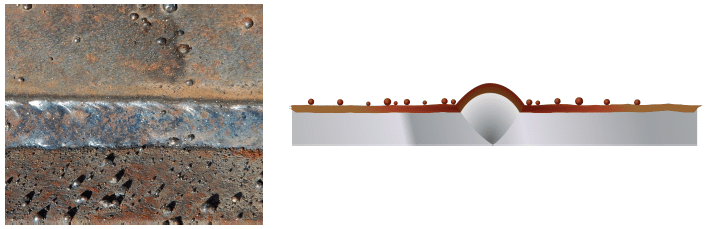
Weld spatter – the small droplets of molten metal that are generated during MIG or MMA welding at or near the welding arc, known as weld spatter, should be removed before/after blast cleaning.
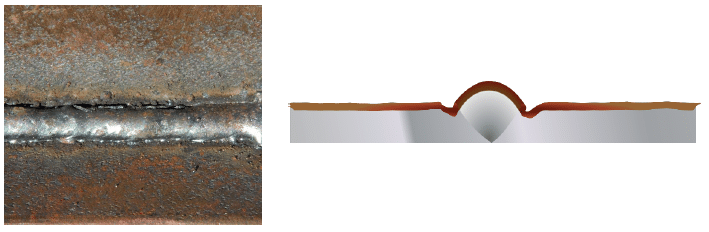
Undercutting (of weld) – any undercuts on a weld must be repaired by welding
before blast cleaning is carried out
Porosity/blowholes – porosity/blowholes should be filled by welding (pre-blast) or
a suitable filler after blast cleaning
Laminations/shelling – laminations or shelling are normally only identified after
abrasive blast cleaning
Inspection Considerations
It’s important to note that while most of the above will be visible before the blast cleaning process, items such as porosity, laminations and blowholes may only be visible once the process is finished. Therefore, prior inspection of welding should be conducted and carried out by a qualified welding inspector, or the client.
This guidance, along with a wide range of additional technical resources, is available through the Corrodere app, designed to support inspectors, technicians, and coating professionals throughout their careers. The app also provides access to digital ID cards, renewal reminders, training resources, industry updates, and other tools to help professionals stay connected, compliant and informed within the industry.
Recently completed my Icorr Level 1 and Level 2. David Eyre is exceptional training; I highly recommend anyone that is keen to get into the industry to take up Icorr training and certification. The blend of Theory and Practical makes the certification a standout point for me personally. High five for everyone at the Corrodere Academy all the way from New Zealand!
Corrodere is a top quality online course and exam too! I have found very easy to use and was extremely helpful to understand all about the coating industry. Highly recommend them!
Top Quality Online Training , easy to use system for Tutorials and Exams Online. Office Coordination and management staff top class. Would recommend 100%
I have passed Icorr Coating Inspector level 3. The trainer are always ready to assist and simplify in order to understand every lesson in the best way. The support team always ready and given details information required. thank you very much for your support and assist.
Really professional courses, estremely useful for the purpose and straight to the point. The trainers are always ready to help and simplify in order to understand every lesson in the best way. There are no other courses in our field valid as the ones Corrodere proposes. Highly recommended!
We use cookies on our website to give you the most relevant experience by remembering your preferences and repeat visits. By clicking “Accept”, you consent to the use of ALL the cookies. Please view our privacy policy for more information.
This website uses cookies to improve your experience while you navigate through the website. Out of these, the cookies that are categorized as necessary are stored on your browser as they are essential for the working of basic functionalities of the website. We also use third-party cookies that help us analyze and understand how you use this website. These cookies will be stored in your browser only with your consent. You also have the option to opt-out of these cookies. But opting out of some of these cookies may affect your browsing experience.
Necessary cookies are absolutely essential for the website to function properly. This category only includes cookies that ensures basic functionalities and security features of the website. These cookies do not store any personal information.
Any cookies that may not be particularly necessary for the website to function and is used specifically to collect user personal data via analytics, ads, other embedded contents are termed as non-necessary cookies. It is mandatory to procure user consent prior to running these cookies on your website.